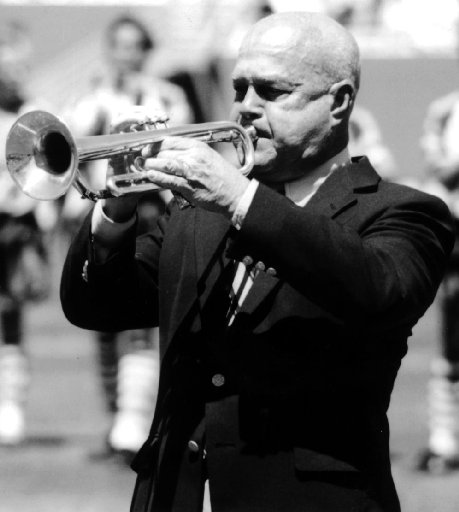
Tommy
Loy, 1930-2002
Trumpeter
Tommy Loy, a Dallas jazz stalwart and Dallas Christian Jazz Band
member, passed away on October 17, 2002, after a battle with pancreatic
cancer.
A renowned Dixieland
player, Tommy is perhaps best known to most Dallasites for his 22-year
stint (1966-1989) as the national anthem soloist for the Dallas
Cowboys. He also performed the anthem at Super Bowl V in 1970, and
was given the BMI Music in Sports Award in 1982.
Born in 1930 in Denison,
TX, Tommy attended Southern Methodist University in Dallas before
enlisting in the U.S. Air Force, where he played with and conducted
bands. After his discharge, he returned to SMU and finished his
bachelor's degree in music education.
He began playing professionally
in the 1950s, appearing with the Cell Block Seven and his own band,
Tommy Loy and the Loyalists. From 1961 to 1974, he played with Ed
Bernet and the Dixieland Seven, a band which later became Tommy
Loy and the Upper Dallas Jazz Band.
Tommy's
association with the DCJB dates to 1998, when he appeared as a guest
soloist on one track of the group's first CD. He eventually joined
the band full-time, and became one of its most prominent soloists.
He was featured heavily on the band's second CD, Christmas with
the Dallas Christian Jazz Band, and also played on several tracks
for the band's third release, Sermonette.
Other groups Tommy played
with in recent years include the Richland College Evening Jazz Band
and the Razzmajazz Dixieland Band.
Tommy was also prominent
in the Dallas commercial music scene as a musician and recording
engineer for about 35 years, during which he wrote and produced
musical commercials. In 1987, he received his real estate license
and became a broker in 1989.
Some of the above
biographical information was found on Jim Cullum's Landing Web site
(www.landing.com)
Tributes
I first met Tommy when
Mike Magers asked him to join The Dallas Christian Jazz Band as
a soloist for some tunes we were doing. Tommy soon became a permanent
part of the DCJB trumpet section handling improv solos and providing
leadership to all of us. Tommy was always quick to encourage and
offer suggestions on how to make the group sound better. He was
a prince of a fellow, a wonderful trumpet player, and a dear friend.
He will be missed.
Skip Parker,
general manager/trumpet, DCJB
There are so many ways
to describe Tommy. I think the thing that meant the most to me was
Tommy's graciousness. I believe that quality surpassed even his
talent, formidable though it was. Tommy was witty but a very genuine
friend to all.
I had the opportunity
to sit with Tommy and listen to the Salvation Army Staff Band a
few years back. I'll always treasure that memory.
Tommy's stylistic improvisations
were a wonder to me. No matter what the tune or the key, if you
halfway listened, you could always recognize a thread of the melody
chasing through Tommy's improvisations.
I always enjoyed Tommy's
gentle mentoring to his fellow trumpet players. It was never "Look
how it's done" or anything overt, but there was always a fine example
for his fellow music makers to follow.
My life has surely been
enriched by the gift of our brief association. Move over Gabriel,
there's a new trumpet player in heaven!
Randy Morrison,
trombone, DCJB
Tommy will be greatly
missed and will leave a large hole in our hearts and in DCJB. Tommy
is one the biggest reasons that DCJB has improved over the last
several years. We may find someone to take his chair but not his
place.
Tommy and I had lunch
one day so as to discuss some issues that he was having about DCJB.
One of the issues that he was concerned about was the inability
to see his music from time to time during our performances. He suggested
that some type of hat or cap might be appropriate for the outdoor
concerts with bright sunlight and indoor concerts with bright spotlights.
I asked him if he was afraid of his head getting burned. His answer
was, "Thomas, I said I was having trouble seeing. I was thinking
more along the lines of putting them on some of the saxes and one
of our trombone players, there is a horrible glare coming from in
front of me."
Tom Fletcher,
trombone, DCJB
I'll never forget the
joy and humor in Tommy's solos. One night after a DCJB gig where
Tommy had several solos I told him that he always made me smile
when he took a solo. He said, "I've been blessed and I'm glad that
I can share it."
Just last Spring, Tommy
was warming up for a DCJB gig and hit a double high C (no small
feat for any trumpet player). I said, "don't use it up before we
start" and he said "I'm just zeroing in." Sure enough, during the
gig Tommy took a solo a popped the double C at the perfect time.
Tommy was not a high note artist, but he wasn't above using a perfectly
placed note to show that he had it all. What a wonderful soul. He'll
be missed by many.
Dave Stephens,
guitar, DCJB
Tommy collected friends
like wool collects lint. It was my privilege to be his friend in
the Jingle recording business. In the early 50's in the infancy
of the jingle business, I was in Tom Merriman's first group. Remained
"freelance" for many years, but in remembering Tommy, I feel compelled
to say that he was a true joy to work with -- always happy, dependable,
helpful in making all our work run smoothly. He was a great and
sensitive engineer for our product. He even came to our side of
the microphone to join in some of the jingles. A true talent in
so many ways. I saw him last fall (2001) when Susie McCune came
to town for a reunion and I am so glad that we had such a great
time together again for all of our sakes. There are so many of us
that will miss him tremendously!!! If this note could just reach
out in comfort and love to all his family right now, that would
be my wish. Blessings to all of you.
Tinker Rautenberg,
jingle singer (circa 1953-----)
Tooters,
I write with deep sadness
that our listmate Tommy Loy lost his valiant fight against pancreatic
cancer this morning. I know that many of you knew Tommy only through
TPIN. His comments were always wise and even-tempered (that's a
hint for some of y'all--wink). I regret that more of you did not
know him personally. And I truly regret that many of you were not
ever able to play music with him. It was always fun and definitely
an honor. Besides being a great player, Tommy was a master sound
engineer who worked in the jingle industry in Dallas for years.
As we say, he had real big ears.
A few memories: I am
a comeback player after a 30-year hiatus. I picked up my horn again
after the 50th anniversary celebration at UNT in 1997. Many fine
players were very supportive and encouraged me in my return, offering
advice about practice regimens, demonstrating playing techniques,
and just helping me stay focused while not losing direction or my
sense of humor. Principal among those have been Pops (whose latest
book is definitely worth the money) Marvin Stamm, and Tommy Loy.
Every time Marvin comes
to play at UNT in Denton, a group of us drive up from Dallas to
hear him. Every time, Marvin augments his wonderful playing with
solid advice and instruction to the NT students. He mentions that
he is always finding exceptional musicians throughout the world
in his travels. And they're not all just in NYC, or LA, or Vegas,
or Nashville. He always tells the students to get out and listen
to the good local players in Dallas/Ft. Worth. And he would always
single out Tommy in the audience for recognition. Tommy had such
a wonderful little boy smile, and he would beam like a six-year-old
when the kids applauded. It was, of course, a gracious thing for
Marv to do, but it was also instructive and accurate: Tommy was
a great player. As he aged, his playing lost a little of its fire
but seem to gain musically. Tommy could play in many idioms well,
but when he played the traditional jazz he loved so well, I always
heard Bix and Bobby and Warren. Marvin once told me that he didn't
think that Tommy knew how good he really was. I agree. Marvin also
got Tommy to come to a sound check for his small group concert at
IAJE in New Orleans in 2000. And he acted on Tommy's suggestions
and improved the setup.
I play in a couple of
big bands in Dallas, and Tommy would sub in those bands regularly.
One is a rehearsal band (Swingtime) that Bob Strickland started
and ran until he moved to the Portland area recently. That book
has some tricky older arrangements that are always a challenge--stuff
like Billy May charts. The joke line to our good lead player, Rob
Jonas, is "just play it like Gozzo"; his response is an ironic "sure".
Tommy would always play the solos in the idiom of the specific chart,
and the lines would be lyrical and sweet. He'd play hot when needed
or cool if more appropriate. He played great plunger, and got the
most interesting effects using an empty orange juice can in and
out of the bell I've ever heard.
The other band is more
of a society band (Celebration Orchestra) that plays weddings and
country club dances and such. (Aside: we recently played for a reunion
of a WWII infantry unit! We played every Miller chart in the book,
and they knew how to dance to them. It was a blast.) When Tommy
subbed with us, I saw the same thing happen in that band. Many of
the younger players wouldn't know who Tommy was at first, but when
he played that first solo (especially on a swing number), they'd
crank their heads around and look at him after a few bars. Then
they'd turn back around and I swear you could see them physically
hunker down a little and start play more focused, in effect saying
we'd better straighten up if we've got to play with "that old guy".
He simply raised the musical bar for the rest of us. Thane Tolle
(a bassist of Tommy's generation) is the founder and semi-retired
leader of that band. When he was still leading us and Tommy would
play Bobby's solo on String of Pearls, Thane would look up at him
with a very bright twinkle in his eye. During the break, he'd say,
"he sure knows how to play those triplets, doesn't he?" And I'd
reply, "he surely does." Now many of us can play that solo in our
sleep because you never should improvise there-the audience thinks
that solo is a part of the chart (and maybe it is). But you never
heard it played better. He punched the accents in those triplets
exactly like the original. And he played just as evocatively on
In the Mood.
Some of you may also
know that Tommy played in the Dallas Cowboys football band for 22
years (when Tom Landry was coach). For every home game, Tommy stepped
down to the 50-yard line and played the National Anthem. Try that
for a little pressure! John Haynie once told me he went to a home
game when it was so cold you could barely feel your fingers. Professor
Haynie said something like, "I don't even know how he felt the mouthpiece,
yet he played solid and pure with a real big sound. I think he's
a great player."
We're all excited that
ITG will be in Fort Worth next year, and it's a real shame that
Tommy Loy won't be there so many of you could meet him or hear him
play. I don't know where it is exactly that we go in the next realm,
but somebody just got a hellava trumpet and cornet player, and their
band is swingin' harder. You can take that to the bank.
John Gunter,
forwarded by Fred Allen
I met Tommy a several
years ago through our mutual friend Bob Strickland, and we quickly
became fast friends. Tommy was like an older brother to me and I
can honestly say that I enjoyed all of our times together, whether
it was going to hear a visiting jazz player, playing along side
each other in DCJB, traveling to and from gigs, our regular trumpet
fanatic Tex Mex lunches at Juan's Cantina, talking and trading horns,
telling stories or just kicking back while working out all the various
problems of the world.
Tommy expected a lot
of himself and was always looking for ways to improve his playing.
Despite often being busy with business and running between engagements,
he always had time to give a good word to his friends and anyone
else who asked.
I learned a lot from
Tommy about musicianship, improvisation, the beauty of traditional
jazz and the value of having and being a true friend. I will really
miss picking up the phone and hearing his exaggerated two syllable
"How-dy!" but will try to live up to his high standards as a player
and friend, until we can meet again.
Mike Magers,
trumpet, DCJB
Tommy was one of the
funniest guys I ever met. We played together, in the Richland College
Thursday Evening Big Band, for several years. We had met a few years
before, when he used to come out and hear my band, "Swingtime 2000,"
rehearse and even subbed a few times. We hit it off, immediately,
because we both have that strange, off the wall, trumpet player
sense of humor. We would spar back and forth and I actually rendered
him speechless a few times! Mostly, I remember how he always treated
me like an equal, despite the fact he had many more years of playing
experience than I, and was very supportive of my attempts at improvising,
though I'm mostly a lead player. A group of us, would meet for lunch
from time to time, and he was always the highlight for me. It's
fair to say, I loved him like a father a brother and a friend all
wrapped up into one. A week ago, was the last time we spoke. Shirley
(his wife) answered the phone and passed it over to him. The first
thing out of his mouth was "Practice!", then a weak little laugh.
So practice I will, and I will always see that bald little head,
with the bright blue eyes, sitting next to me, cheering me on.
Rob Jonas, Dallas
area trumpet player
I was blessed to be
part of the "lunch group" in Dallas with, among others, Tommy, Johnny,
Mike, and Rob. What a treat it was each time we got together. Tommy's
impish smile never failed to brighten my day. He was a vast storehouse
of wisdom and knowledge gained from real life. I always wished I
could "download" a lot of that because I will never have those types
of experiences.
I also was fortunate
to see a side of Tommy many never did. As a Title Attorney, I worked
professionally with Tommy in his part-time residential real estate
business. His concern about his clients' well-being was matched
only by his ability to make a business deal and insight in the transaction.
Closing his transactions and "talking business" with Tommy is a
highlight of my closing experiences and ones that I will never forget.
I attach a picture taken
3 years ago when several of us went to Denton to see and hear Marvin
Stamm perform. (Not many guys can wear a beret with such style.)
Even though Marvin's playing was beautiful, I was most impressed
with the warm friendship and mutual respect and admiration expressed
between Marvin and Tommy. I realized then that the time I was going
to spend with Tommy, no matter how long or how brief, would leave
me with lasting memories.
Tommy, I will miss you
often.
David Griffin

Kneeling: Johnny Gunter; Left to right on second
row:
David Griffin, Bob Dain, Marvin Stamm, Tommy, Richard Bullock, Mike
Magers
When I first got to
town back in '83 I met Tommy Loy on a gig. He found out about me
through some other people and he needed a sub drummer one Sunday
night for Jack Allday up atop the Doubletree Hotel in Dallas when
they were doing the gig up there. On breaks we talked about the
many people we knew and just how small a world it is. He asked me
this question, "So, with a last name like 'Breaux' are you a 'genuine
coon-___?" I told him I had a little German in me but for the most
part I was definitely a Cajun from bayou country. I'm originally
from New Orleans but my Dad's side are all from extreme south Louisiana.
From then on everytime I subbed on the band and Tommy introduced
me he would say, "...on drums we have sitting in with us tonight
none other than 'Bobby Breaux, G.C.A' " Sometimes he would explain
to the audience what G.C.A. meant, if it was the right kind of crowd.
G.C.A. = Genuine Coon-___.
I'll miss Tommy dearly.
He meant a lot to me in that he was extremely helpful in introducing
me to people when I was very, very new in town.
Bobby Breaux,
G.C.A.
It has been written
that leadership traits can be detected at an early age. Tommy Loy's
youth would provide solid support for this premise. He was clearly
a cut above the rest in Miss Lewis' first grade class at Denison's
Central Ward School. He was also a star drummer in the schools Rhythm
Band (see photo Ð Tommy is standing in front of his teacher, looking
to his left and with his drum at an angle). For the remainder of
his years at Central, Tommy would be a standout whether as a student,
musician, or second baseman on the softball team (our only "organized"
sport). The same behaviors continued through high school.
An
old stereotype of musicians was that they were sissies. This notion
may have been held by the school's largest bully the day he "picked
on" Tommy. What a mistake! The best left hook you would ever
see brought the bully to his knees and greatly improved his disposition.
You might wonder how a little guy like Tommy would take on a big
fellow. Truth is, Tommy was one of the larger male students in our
8th grade. He just never grew a lot afterwards; at least not physically.
He grew in every other important way.
Most
of us freshman boys in high school couldn't get a date with age-mates;
they wanted to date more sophisticated upperclassmen. Tommy normally
escorted a great looking junior. In his eleven years of public school
(we skipped the 6th grade), Tommy was in at least four musical groups;
the Rhythm Band, Ms. Bodamer's orchestra, the Denison High School
Band and the Jacket Jivers (a small dance band he formed).
At age 11, Tommy played
first trumpet in Ms. Bodamer's orchestra. This middle-aged, German
woman, with dark eyes that could stare an extra hole in a clarinet,
was our teacher. I wrote "age 11." What I meant was that
I was eleven and Tommy was eleven going on twenty. He was always
mature beyond his years. At fifteen he was a three-year veteran
in the high school band (recruited right out of Central) and served
as an agent for several of us.
Tommy got us our first
gig (or whatever it was called in 1945) with a black band led by
a gentleman named D. X. Brooks (Theme song: "The Green Grass Grows
All Around, All Around."). We were booked for only one night at
a local nightclub, Tropical Gardens, but made a whopping fifteen
bucks each, not bad in 1945. We became professionals overnight.
That summer, he got us another job lasting six weeks at Rio Vista,
a boy's camp near Kerrville. Tommy included me, Charlie Beggs (trombone)
and George Mosse (saxophone) who still plays in Las Vegas. (We are
all in the Rhythm Band picture). Our task was to play at dances
involving our camp and various girls' camps in the area. The problem
that summer, a huge one, was a polio epidemic that restricted us
to the camp. We did entertain some during the lunch hour but mostly
it was tennis and canoeing on the Guadalupe. We also played in a
basketball tournament but because we musicians kicked tails, we
were soon removed from the competition by the camp's administration.
Can you imagine how this went over with Tommy? He was determined
to be the best he could be in every pursuit and was very competitive,
including athletics.
Several years ago, Tommy
and I resumed corresponding; this time via the telephone and Internet.
I had the trumpet bought from him in 1944 reconditioned and e-mailed
him a picture. He seemed pleased that it appeared to be in such
good shape even though it hadn't been used in quite a few decades.
The most recent topic was our upcoming 55th high school reunion
in which he was to serve as master of ceremonies. When the time
came to perform, for once in his life, he was simply too exhausted
to make an appearance. It took a huge obstacle to keep him off stage.
Tommy's memorial service
reminded us that he was not just a hero of his classmates, but was
highly respected and loved by others representing many age levels
and walks of life. I had a brief conversation with Jim Cullum two
years ago and he related how much he admired Tommy personally and
his outstanding talent. His appearance at the service seemed to
confirm this sentiment. Tommy's passing leaves a huge void.
Bobby Noe, DHS
Class of '47
Moving to Texas from
another state and seeking playing opportunities, I found 99.99999999%
of the musicians very gracious and supportive of my playing pursuits.
I remember sitting in my trombone section -- minding my own business
;) -- and all of a sudden hearing this wonderful solo from behind.
I turned around -- saw this fellow -- and thought, wow, I'll have
to say hi to this guy. After rehearsal, I timidly approached him
and said hi and told him how much I enjoyed his playing. Within
a few moments I knew that I have met a special person and our "bantering"
and exchange of ideas began. Not only did I enjoy discussions with
Tommy, but, I also enjoyed all my positive discussions with other
musicians about Tommy. I'm grateful that I had a chance to meet
Tommy.
David Riley, trombone, DCJB
I first met Tommy Loy
-- or I should say, heard Tommy -- in 1954 at Ft. Hood, Texas. I
was a 22 year old just back from Korea in my first year of college
in Lincoln, Nebraska. I was spending Christmas vacation with my
parents at Ft. Hood where my father was in charge of the OB section
at the hospital on base.
I was bored on a Saturday
night, so I borrowed my parents Nash Ambassador and took a tour
of the post, stopping at a NCO Club where a bunch of cars were parked.
Inside was the craziest bunch of guys I'd ever seen, dressed up
in striped pajamas playing hot Dixieland jazz. Very impressive to
me, a weak cornet player who loved Dixieland jazz, but was forbidden
to play it because SDA's don't play the "Devil's Music"!!! I thought
that band was named "Jail House 7."
Fast forward to 1981.
I'm teaching instrumental music in Lodi, California with time on
my hands, so I start a band, and not wanting to copy that band in
Texas, I named my fledgling band "Cell Block 7."
I received a letter
four years later from Tommy Loy!! "Romans!
Where in the WORLD did you come with that name?" He'd seen my band's
name listed for some California festivals. I wrote and told him
the 1954 story, and he wrote back and called me a "Plagiarist" with
a twinkle in his eye and a smile on his face! We became good friends!
I was fortunate to get him involved in some California jazz events
in Sacramento, Pismo Beach, and he went with us to Scotland July
23-August 6, 2002, to play the Edinburgh International Jazz and
Blues Festival. At least four or five times while over there he
told me the trip was the culmination of a life-long dream to play
in Europe with a Dixieland band. The fans loved him, as did Cell
Block 7. He was so warm and caring for everyone in the band, played
so beautifully, and sang the same way. We all hated to see the trip
end!
Then, about one week
later, the terrible news from his doctor ... We have lost a giant
from our midst, and he is terrible missed by me. His funny e-mails,
his clever wit, his great advice and help, his smile ... Goodbye,
my friend!!!
You can see pictures
of Tommy with Cell Block 7 in Scotland on my Web Pages below. Tommy
is almost hidden by the tuba player in one of the pictures ...
Bob Romans, Cell
Block 7 Jazz Band
Lodi, California
www.cellblockseven2002.net
>=iii=<0